Introduction
The convergence of 3D Printing and 3D Visualisation with AR (Augmented Reality), VR (Virtual Reality), MR (Mixed Reality), XR (Extended Reality), Digital Twin, and Artificial Intelligence (AI) represents the next phase of intelligent product development and immersive engineering ecosystems.
This integration creates a seamless connection between design, simulation, immersive interaction, physical production, and real-time performance monitoring, enabling industries to move from static manufacturing to dynamic, data-driven innovation environments.
1. The Integrated Technology Ecosystem
1.1 3D Printing (Additive Manufacturing)
Enables production of complex geometries directly from digital models with reduced material waste and faster prototyping cycles.
1.2 3D Visualisation
Transforms design data into realistic, interactive models for analysis, simulation, training, and stakeholder communication.
1.3 AR / VR / MR / XR
- AR overlays digital information onto the physical world.
- VR creates immersive digital environments for simulation and training.
- MR blends physical and digital objects for real-time interaction.
- XR serves as an umbrella integrating all immersive technologies.
These tools allow engineers, designers, surgeons, architects, and operators to interact with 3D data before physical production.
1.4 Digital Twin
A live virtual replica of a physical asset or system that continuously updates using sensor data and operational inputs.
1.5 Artificial Intelligence
AI enables predictive analytics, generative design, simulation optimisation, defect detection, and autonomous decision-making.
2. How the Technologies Work Together
- AI-driven Generative Design creates optimised 3D models.
- 3D Visualisation platforms simulate performance and validate design.
- AR/VR/MR/XR environments allow immersive testing and collaborative review.
- The final design is manufactured using 3D Printing.
- A Digital Twin monitors real-world performance.
- AI analyses operational data to refine future designs and processes.
This forms a closed-loop intelligent lifecycle system.
3. Key Benefits
3.1 Immersive Design Validation
- Stakeholders can review full-scale 3D models in VR before production.
- AR assists engineers in identifying design flaws early.
- Reduces costly physical prototypes.
3.2 Faster Product Development
- Virtual simulations reduce testing cycles.
- Real-time collaboration across global teams using XR environments.
- Rapid prototyping through 3D Printing shortens time to market.
3.3 Improved Accuracy & Quality Control
- AI detects anomalies during printing.
- Digital Twin compares real-time data with expected performance.
- AR assists technicians in assembly and inspection.
3.4 Enhanced Training & Skill Development
- VR-based training for machine operators and surgeons.
- MR-guided maintenance support.
- Reduced risk and cost in high-precision industries.
3.5 Predictive Maintenance & Lifecycle Management
- Digital Twin continuously monitors equipment.
- AI predicts wear, failure, and optimisation opportunities.
- Enables proactive maintenance planning.
3.6 Mass Customisation
- Personalised medical implants and prosthetics.
- Custom architectural components.
- Bespoke industrial parts optimised for specific applications.
4. Industry Applications
Engineering & Manufacturing
- Immersive product design reviews
- Smart factories with Digital Twin dashboards
- AI-optimised additive manufacturing
Healthcare
- AR-assisted surgical planning
- VR-based anatomy simulation
- Patient-specific 3D printed implants with Digital Twin monitoring
Architecture & Construction
- Virtual walkthroughs before building
- 3D printed structural components
- Digital Twin-based building performance monitoring
Education & Skill Development
- XR-enabled 3D technology labs
- Immersive engineering curriculum
- Simulation-based innovation platforms
5. Strategic Significance
For emerging technology ecosystems like those promoted through 3D GEM and 3D GRAPHY, this integration:
- Accelerates Industry 4.0 and Industry 5.0 adoption
- Strengthens Indigenous 3D Technology capability
- Encourages start-up innovation in immersive and intelligent systems
- Creates high-value design-to-manufacturing ecosystems in India
Conclusion
The integration of 3D Printing, 3D Visualisation, AR/VR/MR/XR, Digital Twin, and Artificial Intelligence moves industries beyond conventional manufacturing into intelligent, immersive, and predictive environments.
This convergence enables organisations to design smarter, produce faster, train better, maintain proactively, and innovate continuously—creating a sustainable and competitive technological future.
3D GEM is a 3D Technology Consortium formed precisely with the same intent to promote all the 3D Technologies through the 3DGEM 2026 event.
3D GEM (3D Graphy Engineering & Medical) — Platform Overview and 2026 Editions
Executive Summary
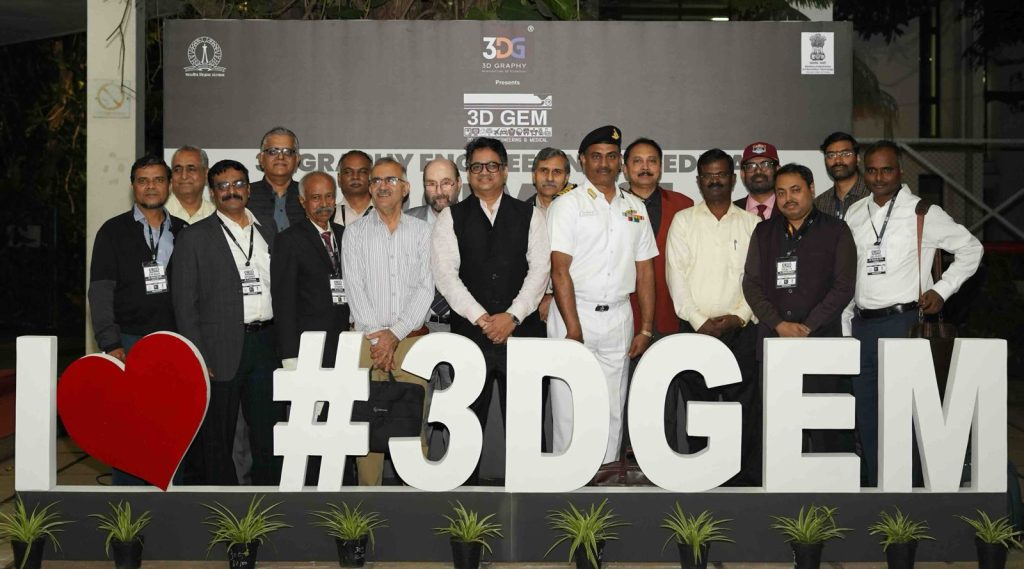
3D GEM is India’s premier integrated platform dedicated to the advancement, application and adoption of 3D technologies across engineering, healthcare and allied sectors. Organized by 3D GRAPHY LLP and supported by leading host partners (IIT Bombay, IIT Delhi, IISc Bengaluru) and the Government Partner MeitY, 3D GEM brings together academia, industry, policy makers and end users to share research, showcase technology, solve national challenges, and recognize excellence.
Mission / Theme (Constant across editions):
Democratising 3D technology through education and research to benefit all.
2026 Milestone: For the first time 3D GEM will run two editions in a single year — widening scope, regional access and industry reach:
- 6th Edition: 28–29 May 2026 — Seendripu Krishna Murthy, Lecture Hall Complex – 3, IIT Bombay.
- 7th Edition: 26th -27 November 2026 — IIT Guwahati.
Across editions 3D GEM engages 30+ industry associations and end users from Engineering, Aerospace, Automotive, Space, Shipbuilding, Heavy Industries, Energy, Dental, Medical, Pharma and related sectors.
The Six Key Active Platforms (Detailed)
Each 3D GEM edition runs seven active, interlocking platforms designed to engage a wide audience and drive outcomes from concept to application.
1) Conference (Engineering & Medical)
Purpose: Technical program that spans fundamental research, translational work and industry case studies in engineering and medical domains.
Core elements:
- Keynote addresses by industry leaders, senior academics, and government representatives.
- Thematic plenaries: Additive manufacturing at scale; bioprinting and regenerative medicine; digital twin & AI in manufacturing and healthcare; standards, regulation and quality management; materials development and characterisation; post-processing and finishing technologies.
- END USER TALK – will include speakers talk about problem statements and testimony with benefits and the use of 3D technology in Engineering, Industrial manufacturing, Dental and medical.
- RESEARCHER TALK – will include researcher making new head way in 3d technology and solutions.
- 3D TECH TALK – will include 3D Tecnology companies and 3D Experts make presentation about the latest 3D technology available.
Intended outcomes: cross-sector knowledge transfer, collaborations, policy feedback and clear industry-academic project leads.
2) Exhibition
Purpose: A curated marketplace and demo floor where technology vendors, startups, research labs and service providers display hardware, software and materials.
Exhibitor categories:
- 3D Printers: Polymer, Metal, Composite, Bioprinters
- Scanners: structured light, laser, CT-based industrial scanners, intraoral scanners
- Software: CAD, modelling, simulation, process planning, slicers, validation & verification tools
- Materials: filaments, resins, metal powders/wires, composites, bioinks, specialty polymers
- 3D Visualisation & Digital Twin: AR/VR/MR/XR solutions, AI-driven visualization and remote collaboration tools
- Post-processing: sintering, heat treatments, surface finishing, metrology & inspection tools
Value to attendees: live demos, proof-of-concept builds, procurement scouting, product launches and pilot collaborations.
3) Poster Presentation
Purpose: Platform for students, researchers, and industry R&D teams to present concise, visual research and development results.
Format & evaluation:
- Poster gallery open across both days with scheduled poster walks for judges.
- Categories include: fundamental research, translational engineering, medical applications, materials & processes, software/algorithms, and student projects.
- Awards: Best Student Poster, Best Industry Poster, Judges’ Choice and People’s Choice.
Benefits: visibility, networking with industry mentors, potential for seed funding and invitations to collaborate.
4) National Grand Challenge
Purpose: A flagship program to accelerate indigenous 3D technology development—hardware, materials, software and integrated systems.
Focus: problems of national relevance across manufacturing, healthcare, infrastructure and defence; encourage end-to-end Indian solutions.
Structure:
- Call for proposals (open national invite). Shortlist based on technical merit, feasibility and social/industrial impact.
- Mentorship from industry and academia; access to testbeds at partner campuses.
- Finals at the event with live demonstrations and evaluation by a multidisciplinary jury.
Purpose: A meeting interaction between the End user and the Service Provider.
5) Design Challenge
Prizes & support: cash grants, incubation support, pilot deployments with industry partners, government matchmaking.
Purpose: Stimulate design thinking and creative application of 3D technology to solve user-centred problems.
Target participants: undergraduate & postgraduate students, designers, early-stage startups.
Themes: annually chosen — examples: low-cost assistive devices, modular prosthetics, sustainable packaging, rapid field-repair components.
Deliverables & format: conceptual designs, CAD files, rapid prototypes and a presentation of testing/validation plans.
Rewards: awards, prototyping grants, commercial mentorship and possible exhibition shelf space.
6) Awards
Purpose: Recognition across categories to spotlight technical excellence, innovation, adoption and social impact.
Award categories (sample):
- Lifetime Achievement in 3D Technology
- Best Industrial Adoption (Engineering)
- Best Clinical Translation (Medical)
- Most Promising Startup (3D Tech)
- Best Student Project / Thesis
- Best Indigenous Product (hardware / material / software)
- Best Poster (Student, Industry)
- People’s Choice Awards
Jury: cross-disciplinary: academic peers, industry technical leads, government representatives and end-user judges.